Sunday, April 20, 2014

Blog Post #3

In the third section of the book, Ghada Karmi talks about how she went back to Palestine, or Israel, as it is called now. She is trying to see if anything is familiar, and how her homeland has changed over the years. When she returns to it, she discovers that the country has been changed into a modern, highly populated country with much commercialism and modernization. She is rather disgusted because there are still villages where Arabs live, but this is right next to a big bustling city with tidy straight lawns and modern apartment complexes. The Arab villages are very full of poverty; the Jews and Israelis do not care about the Arabs, who were there before. I am so shocked that after so many years, the Jews have thought about what they did and haven't tried to solve the problem. The government is now being run by the army general. This is so bad that now the head of the country is the army. I have one message for the Jews and Palestinians: Sit down in a room. Put away ALL your guns and weapons. Put them somewhere where you won't touch them for years. Now, talk. Talk about all your worries and why you hate each other. What are ways you can get to be on talking terms. Now, see if you can't try and SHARE your land. Make peace with one another, and just stop fighting. Honestly, how hard is this? I believe that removing violence from both sides of the equation will result in a positive sum. If the leaders of both countries meet without any forms of violence and talk about the problem, then they can easily solve it and have peace. The teachers at school are teaching this to their kids, when the ones who need it most are the ones who seem to think that child slavery, feminine abuse, and electing an army general as president are okay. Get the word out there that the world is a sad place. It used to be a wonderful place filled with love, peace, and beauty, but men are making the world ugly. The Earth is dying slowly, and it is our fault. So, if we sort out this little problem, then maybe we can take a look at the problem at hand. Saving the Earth and reducing our use of plastic!!!!!!
BLOG POST #2
The thing that really made me wonder is the "kinship ties", how Muslims have to know each other's history, where they came from, who their family was. It's really different from our culture, how we don't really care where someone comes from, and who their family is. On page 185, Ghada describes how meeting other Palestinian families in Golders Green was exciting for her mother, because it was a way for her to determine where they came from, and also to have relief that the country was still there and it hadn't disappeared mysteriously. She also explains that sometimes just the surname is all that is necessary to determine one's place of origin. "Kinship is the most basic principle of putting individuals into social groupsroles, and categories. The basic sort of kinship is to belong to the same family by birthKinship tells us how we are related to our family or each other, through our biology and history. Kinship can be a complex system of social groups. It is a universal system as everyone has a family. Some small and large scale societies use kinship not only for human reproduction but for “economic transactions, the political system and [their] religious beliefs” (J.Hendry, 1999)." "Kinship." - Simple English Wikipedia, the Free Encyclopedia. Wikimedia Foundation, 21 Oct. 2013. Web. 20 Apr. 2014. Through kinship, we can find someone's origins just by knowing the level of class, because for example if someone was of the peasant class, then they would use their father's first name as their surname. For example, I were of that class, my name would be Tristanio Alfredo, because that is my father's name.

Monday, March 31, 2014

Trying to oppose the oppressed is not a good idea.

(This is what my first post was on paper)
On page 59 through 61 the incident that Ghada was talking about was brought about by the Irgun organization. They were group of Jewish people who resorted to acts of terror and violence to try to get the Jewish state fully Jewish. Many of their acts were on Arabian people but from 1939 onwards they attacked many British officers and soldiers stationed in the area. They used bombs for many of their attacks, placing them in crowded areas such as movie theaters and marketplaces. When they attacked British military, many of the fights turned to shootouts. The most violent acts that the Irgun gang performed was the bombing of the King David Hotel and the Deir Yassin massacre. The "big brother" of the Irgun was the Haganah, who are more of a politically inclined group. One of the more atrocious acts of the Irgun was the hanging and booby trapping of two British officers. When another officer went to cut them down, a mine underneath them detonated in their faces. The Irgun also had many battles with British soldiers during the time when most Palestinian people were being pushed out of what is now Israel.

Wednesday, March 26, 2014

The Mosque

           The technical diary part of the book shows Ghada's slow descent into emotional depression. It is a sad part indeed when she is walking around and finding that everything she had grown up with was either gone or ruins. one of the saddest parts is when she see the mosque in the middle of the square(pg-435). When I was reading that part I thought the mosque was Palestine and all the high-rises were Israel. The mosque is empty and forgotten by most of the people who used to go there, and neglected by those who live near there, though the high-rises immediately catch your attention and make you go "wow!" The wall that separates Israel from Palestinian settlements is directly showing that the Israeli's do not even want to look at Palestine. They main part of the third section is about the feelings but it has other elements as well.

Friday, March 21, 2014

THIRD BLOG POST

In the last section of the book you really feel the underlying tone of frustration and hurt. She is now old enough to feel and see this true pain, and it hits her really hard. All hope Ghada has comes to an end; a final catastrophic ending. She could not look upon the world with the same light she had as a child. They had invested everything into The Palestinian way of life. Trying to keep it alive, but it fails. This is what underlies that last third. A feeling of defeat. "I was wrong. The hope I had in 1978 came to nothing, neither for Palestine nor for me" (p 410). The words she uses for the last moments underline the fact of her frustration and hurt. Shortcomings; suffering; lost hope; abandon and stranded. Nothing about her situation could be glorified. It was raw.

Thursday, March 20, 2014

In the third section of In Search of Fatima the tone of somberness really stands out. After returning to the Arab world in search of companionship and understanding but not finding much, Ghada describes  her insecurities,"Two years in the Arab world had not helped me find my roots. Rather I began to fear that I had none to find, at least not in the places where I had sought them." (page 420). It is evident that Ghada has really lost her way, she does not know where to call home or what to identify herself as. Ghada is unable to pick up on many Arab social norms because of her vast exposure to the English culture and yet cannot fit in in England because of her loyalty to the Palestinian struggle. The truth is that Ghada doesn't have a home, she doesn't fit. Because of her homelessness Ghada is understandably displaced.


My favorite part of the whole book is the footnote that is on page 292 that describes her run in with Zoe Steiner years after their initial headbutting, "Zoe and I met again by chance in 1983. She was a dentist and I a practicing GP. We fell upon each other and embraced like long lost friends. She invited me to her home (also in Golden Green) where she introduced me to her Orthodox Jewish husband. Over a kosher meal, we reminisced over that incident in our childhood and shook our heads at the passions we had both felt." Despite how much I disliked Zoe Steiner's actions and rooted on Ghada, I recognize the incident as a painful memory for both girls. The fact that they met again and were able to come to terms with each other and the situation is so remarkable because rarely does such an opportunity come up. The anecdote of their future meeting allowed me to understand the initial situation more, because they ended at peace I didn't feel like I had to chose who was right/wrong, but rather I was able to recognize the causes for both of their actions.
The Final third of In Search of Fatima has no single emotional tone. It is a montage of very strong emotions, including defiance, hopelessness, and elation. However, the final third does include something that sets it greatly apart from the rest of the book: while the sections Palestine and England are mostly just the life experiences of Ghada Karmi, and her relationships with various countries and people- the final third is a deep reflection of what it means to be displaced, and representation of one woman’s search for the truth.  In this quote, Ghada speaks fervently to us about the emotional attachment that she forged by being an activist for Palestine, giving her something to fight for: “By the mid-1970s I had latched passionately onto the cause of Palestine as an inspiration, an identity, a reason for living” (399). This second quote takes place when Ghada  goes back to Palestine and tries to find her childhood home, finding instead, a new building on the site where it once stood, causing Ghada to fall into hopelessness: “Whatever is the point of struggling now… no one now remembers what we did or cares. It made no impact on events and things for the Palestinians have only gone downhill since then. Might as well accept we’re finished” (45-46). Upon hearing the call to prayer spreading through the old city, Ghada feels elation; “I closed my eyes in awe and relief. The story had not ended after all.” The final and most important piece of reflection in the entire book occurs in the last paragraph; “The story had not ended, after all. Not for them, at least, the people who still lived there, though they were now herded into reservations a fraction of what had been Palestine. They would remain and multiply and one day return, and maybe overtake. Their exile, undefined by space or time, and from where I was, there would be no return” (451). This final testament embodies the pain and hope of all displaced Palestinians. It would seem that Ghada wrote this book as a way of dealing with her own displacement, a gateway for the rest of the world to understand, and in so doing give Ghada herself legitimacy. Ghada’s last paragraph (the quote on page 451) mirrors my emotions when I am in my house in Jerusalem- every evening, the beautiful, wringing sound of the call to prayer reaches out over the land that has been so disputed for millennia, reminding the world that we are still there.
“The doors are gone, but the Keys remain”


My favorite part of the book is by far the third section. The first two sections are good, but the fact is that they only portray the life of one person, whose  journey, while interesting, is mostly one of a failed attempt at cultural integration, as well as of course some important, factual information about the takeover of Palestine. The last section of the book however paints a very real and touching picture of the plight of someone who has had the horrific epiphany of belonging nowhere.  The overwhelming confusion and emotional chaos brought about by displacement is truly life shattering- but despite that, Ghada Karmi has been able to record these thoughts  (mostly in the last third of the book) for all the world to see, and what’s more- she has not lost her hope, but reclaimed it.  

Blog Post 3

The tone of the last section of In Search of Fatima is resentful. Ghada's life has a series of tragic events that have caused her to lose connection of her culture she grew up in as a child. Upon visiting what is now Israel,  as an adult, she sees the memorial and government buildings made by the State of Israel, "I visited the Israeli parliament, built on the flattened and now unrecognisable land f the Palestine village of Lifta... The Holocaust museum nearby was also built on confiscated Arab Land... Outside, a humble Palestinian gardener in shabby, soiled clothing pulled weeds and dead flowers from the beds, making the place pretty and neat, oblivious of its significance" (440). Ghada has watched this land change from home of her people to be destroyed, and then rebuilt up for the religious group whom she has always resented. It must be painful and angering to have to see this. All of these emotions she has, because of the hardships she endured, cause fiery resentment within her. This quote clearly outlines her resentful tone of thought which carries throughout the last part of her story.

My favorite part of the book is watching Ghada as a young girl interact with Leslie's Jewish Family. She acknowledges that this is the first Jew she ever befriended. It is fascinating to see these girls connected because of similarities, they are both outcasts as result of their religions in school. While their ethnic groups are across the world raging at war they have found friendship in one another. They don't understand the severity of war, and therefore are able to foster a friendship. While they recognized that their cultures are pitted against each other, they still find that they have commonalities, they are young girls growing up among a majority of people who take to a different faith. Reading about Ghada meeting Leslie's family was especially fascinating because of the acceptance they had. It is surprising and  relieving to the reader that this occurred. Clearly, as shown later in the book, not all Arabs nor Jews are able to be understanding, even so this one occurrence puts both cultures in a new light for the reader.

BLOG #3 Tone: Frustration. And My Favorite Part.

          Throughout the book there has been an unmistakable tone of frustration, especially now that Ghada is older and wiser. First, Ghada is frustrated that she has to leave her home. Then she is frustrated that she has to live in England. Then she is frustrated when she is forced to change schools. Now she is older and is starting to resent the unfair treatment given to boys in her culture, “Many a girl might grow up seeing her brothers drinking alcohol, making sexual liaisons and indulging in behavior which would never be allowed her” (299). She also is starting to have an interest in boys and is annoyed that her parents were so hushed about the subject of sex. She believes this made her unexperienced with intimate relationships involving the opposite gender, “I began to look back with resentment on the constrained upbringing and inhibited childhood which thus had disabled me” (305). Near the end of the book when she sees a Holocaust museum built on confiscated Arab land she laments, “There was a brilliant and affecting exhibition of tragic European-Jewish history, skilfully interwoven with the creation of modern Israel; a seemingly logical progression from the gas chambers to Palestine, no omitting pictures of the Mufti of Jerusalem negotiating with the Nazis. It was a deliberate statement about the right of world Jewry in this country” (440). Her transformation from childhood and innocence to adulthood and maturity only brought her more frustration as she gained more knowledge about what really happened to the world she had once known. Her frustrated tone resonated throughout the book, whether she was talking about personal or political issues. She never directly complained, just stated the truth, wording it in a way of subtly expressing frustration about the change and challenge she had to overcome as a Palestinian girl growing up during the creation of Israel.

            My favorite part of the book was when Ghada locked Zoe Steiner in the girls’ bathroom and beat her up. The book had very little action in it, so I always got excited when Ghada told real stories, it made the book come alive. Zoe Steiner totally deserved what she got. She was rude, exclusive and just plain mean. The moment Ghada told us about the book Zoe had written about her I wanted something bad to happen to Zoe. Zoe had no right to write a book making fun of an innocent girl and her culture. Of course, Ghada did take it a little far by saying, “Hitler should have finished the job! He should have killed all of you!” (289). In her defense, however, the horrible effect of Hitler was not yet commonly known among people, especially not known to her. I liked this scene because after being pushed around by her parents, Israelis, teachers, and the British she finally got a sense of justice by standing up for herself. Zoe was obnoxious the moment she met Ghada. After being constantly harassed by Zoe and her little followers Ghada finally got her back by luring her into the bathroom and beating her up (not to badly, though). Sadly, this was one of the few instances where Ghada won her fight for justice.

Wednesday, March 19, 2014

DIRECTIONS for third posting and comment

Third Posting due Thursday, March 20
Third comment due Tuesday, March 25

For this post, write a CCQC that identifies the TONE of the last third of the book.  The claim should include an adjective or two that you think describe the tone, then you need lots of examples/quotes from the book that prove your claim.  Sophs, if you need a refresher on TONE, I have put it up on the Edmodo site.

Then write a paragraph that does one of these things, your choice:
*describes a favorite part of the book
*is a review of the book
*uses some part of the book to comment on an issue that interests you


For the comment, find someone who has a different idea than you do about the tone, or about some other part of the book in their second paragraph.  Add to their evidence, or challenge their idea by countering it with evidence of your own.

Friday, March 14, 2014

Ghada and her brother Ziyad embrace the english culture much more than their sister Siham because they had shallower roots in the Palestinian soil. Ghada talks about the progression of slowly losing her education in Arabic social behaviour  and Muslim religion, she meantions that both ceased when her family left Damascus. She goes on to talk about what she and her siblings retained, from page 219, "Of us three, Siham was least affected, since she was already mature when we reached London, but Ziyad and I fared differently."Ghada's use of the word mature really resonates with me, I think that often use the word matured when talking about physical development, but we also use it to describe someone who has and uses good manners. If you think about it, manners are really a product of the society and culture that one lives within. Siham has matured in Palestine, she has Palestinian culture and manners. Because Ghada and Ziyad are so young when they are uprooted, they really soak up the English culture as they mature.    
-Iris Salin Elan

Thursday, March 13, 2014

An individual gifted with a good life and plucked from their culture to be placed in a new one will never fully adapt to it. This is exemplified by Ghada's mother, and how she reacts to being thrown into the country and customs  of the British. In this quote, Ghada describes her mother’s stubborn tendencies upon arriving in England:  ""We’re not staying." And she put this philosophy uncompromisingly into affect. She refused to learn English, she had no English friends, she would reject any suggestion of decorating our shabby house, or even buying such a basic thing as a refrigerator" (186). This  high level of denial is immediately striking. The other odd thing about the behavior of Ghada's mother is that she does not even take into account both the fact that the U.N. has been completely ignoring the Palestinian refugee crisis and Israel’s continuing seizure of Palestinian land at this time, and that it shows no sign of turning to the issues and facing them any time soon. The change of cultures came far too fast for Ghada's mother, and she was so badly affected that she never made more than one English friend in the forty years that she lived in England. Ghada’s mother’s denial of her situation is obvious proof of the permanent damage caused by the culture shock she underwent following her sudden uprooting from the land of her birth.

Second Blog Posting - CCQC

Cultural Clashes For an Immigrant Family

While trying to adjust to a new world in England, Ghada and her family had a lot to adapt to - even the diversity in food. There are so many tiny things that make up a culture, many of which we overlook. The key parts of defining a culture seem to be food, clothes, and architecture. Clearly, when moving from Palestine to England these three aspects took some adjusting to work on. Ghada describes how she compared herself to the way other women were dressed when she arrived in the airport. She then goes on to talk about how the carpeted floors were so alienating that they tore out the carpet to replace with tiles that reminded her of her old house. Finally, she talks about the food and the difference between what she was accustomed to eating and how the English cooked, "The tea tasted quite horrible because it was mixed with milk, a combination unheard of for us. Arab tea is strong, dark and very sweet and drunk from small glasses. To make this tea drinkable, we put in lots of sugar. Astonishingly, however, our hosts did not take sugar at all," (Page 178). While this seems minor compared to all the obstacles she has had to overcome since arriving in London, this passage stood out. The author was so surprised at the difference in the way they made tea that she chose to right almost a page on the difference between their tea and British tea. In Palestine, tea represents socializing and having guests over, as does it in England, too. The stark difference in the way it is prepared, however, just seems to be yet another reminder that they are not in there homeland. It must be so hard to be reminded daily that you are foreign to a land by little things everyday like food being prepared differently. While this is a minor cultural clash, I can only imagine how heart breaking it must be to have to adapt to little things like this simply because you are not in your homeland and therefor must change your ways to fit in with your new surroundings.
-Jackie Lozaw Elan

It might work...but mabye not.

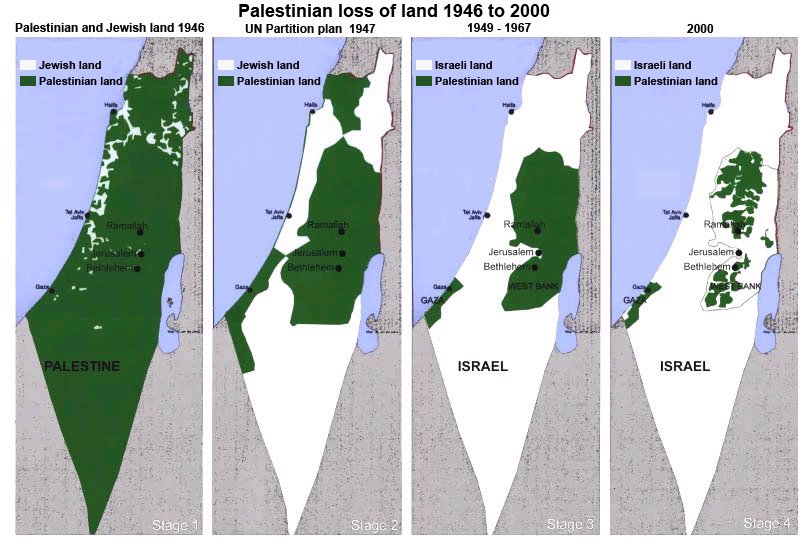
   To fully assimilate another culture is near to impossible.  Many times it has been dissolved into cultural genocide or ethnocide. such cases are the Spanish with the Aztecs, and English settlers with many Native Americans. In the childhood of Ghada Karmi, the cup was just about to boil over. As shown on the two maps on page 35 and page 424. these show how the Palestinian people were crushed into smaller space.  This map shows how the Jewish people came in to Palestine and shredded it.


 The author lived in a small town just inside the West Bank. Now it is deep into Israel territory. as you can see from the map the Palestinian people have completely been squished down into small patches of land. Many of these patches are desert and others are being encroached upon by more Israel settlements. If you research successful cultural assimilation then you just get America saying "we are amazing because we let immigrants in!" All in all, cultural assimilation is a very improbable thing to happen and less Palestine gets more help than they might be all wiped out.

Blog Post 2

Ghada's sister and mother are most frustrated with the lack of help that the Palestinians receive, showing the naive nature of them both. When the family first arrives in Syria for example, Siham is distraught that the people seem to be oblivious of the hardships the Palestinians are enduring, "the sight of people looking normal, strolling about, sitting in the sun, even picnicking on the banks of the river. 'Why don't they look sad?' she asked. 'Don't they know whats happening to us?'" Additionally her mother earlier on, when they were in Palestine, struggles to understand why organizations and countries from around the world haven't helped the Palestinians. They see the terror that the Arabs are enduring, and can't comprehend why everyone isn't rushing to help them, or furthermore morning their hardships. These women have been sheltered till now in their life, clearly displayed by their reactions to the situation. They have grown up in lived in a close knit community where people visit each other everyday and are always their to help one another. Now this has been stripped from them. But even more, they are waking up to the harsh reality that people aren't always looking out for on another, even within their Arab community.

Wednesday, March 12, 2014

Second Blog Posting - CCQC

The Emotional Price Paid By A Displaced Family -

  Ghada Karmi and her family had to take whatever punches where thrown at them. As they where put into England, they become comfortable with being mistreated. "I learned to adapt by clinging to the small routines of life." Growing up Ghada was over looked because she was Arab. Even though Ghada performed just as well as other girls. She had to deal with the fact that should would never be recognized for what she was worth. She was defined by her race and not her skills.  "In point of fact, the little dark girl read the best, but I cannot in all conscience give the first prize for an English recitation to someone non-English (pg 246). Ghada was never given the chance to shine, and I believe that is emotional costing. When you are aways doing your best but never recognized for it. You grow up with a sense that anything you do will be disregarded, and in Ghada case it was true for a lot of things. Lucky for Ghada later in life she was given the chance to be recognized and shine. A lot of people never got that chance. 

DIRECTIONS for second posting and comment

Second posting due Thursday, March 13
Second comment due Tuesday, March 18

For your second comment, write a CCQC, using evidence from the second third of the book.  Make a claim that addresses one of the following ideas:
   * What emotional price is paid by an immigrant/displaced family?
   *  Is it possible to fully assimilate to another culture?
   * What culture clashes do immigrant/displaced people encounter?
   *  Is the experience of displacement different for the older and younger generations?

For your comment, find someone who chose to write about a different question than you did, and ADD to their evidence, using more evidence from the second third of the book.

Friday, March 7, 2014

The Caftan

One of my interests is fashion. I love the art that goes into creating a garment. Some people consider the world of fashion to be extremely superficial, and some parts of it are. However, fashion has always been an expression of self, one that I believe to be as poignant as poetry or painting. The study of fashion will also cause you to discover many more academic subjects such as geography, history, and cultural anthropology. I find it fascinating to research how clothing can both reflect and challenge the world of its wearer. So when I read the passage  in In Search of Fatima concerning the way views on the Caftan had changed, I was instantly intrigued.

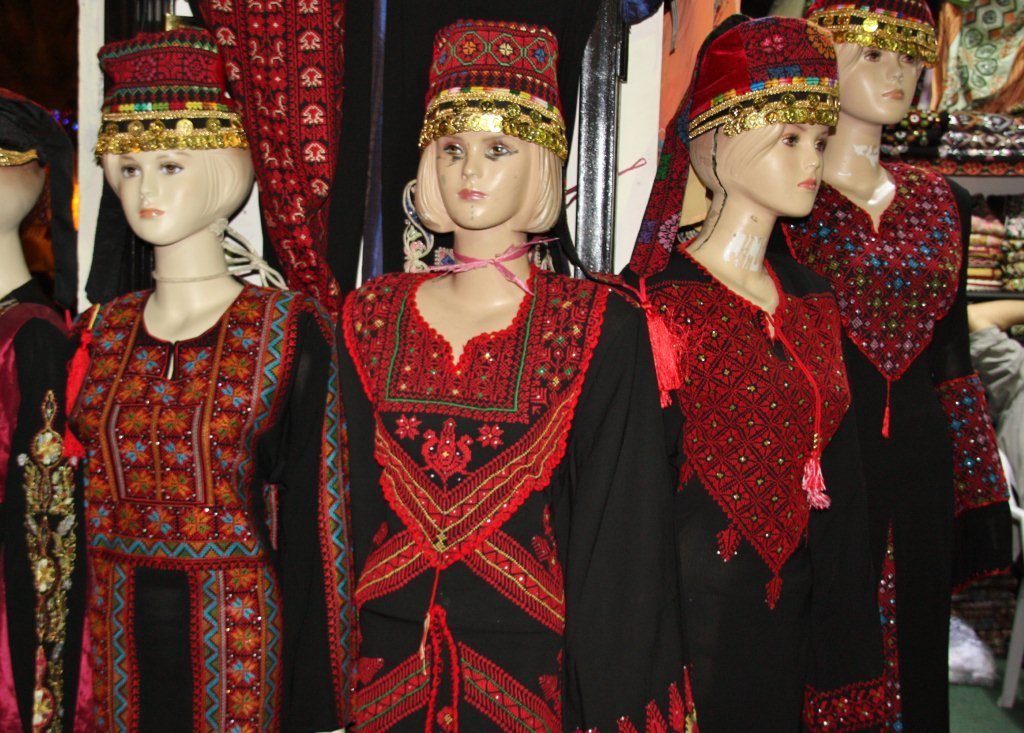
On page 23 Ghada Karmi discusses the Caftan, "No one then could have known that after the loss of Palestine in 1948, this despised peasant costume would become a symbol of the homeland, worn with pride by the very same women who had previously spurned it." 

For those who are unaware, this is what a caftan looks like.

N.d. Photograph. Arabic Zeal. ArabicZeal.com. Web. 7 Mar. 2014.

This made me want to know more about the craftspersonship, origins, and possible meanings of caftans.

According to Wikipedia, the caftan is a coat, or in this case, and overdress that buttons in the front. It is long-sleeved and it reaches to the ankles. Apparently, it originated in Mesopotamia, which means that the caftan has a long history. Since then, it has become a highly fashionable style of dress which is worn in many cultures. Traditionally, the caftan was worn by both men and women.

I find it funny that Ghana's mother found the caftan to be so plain, because only a while later the caftan became the height of fashion, being sported by celebrities such as Elizabeth Taylor and Grace Kelly.

The caftan is still highly fashionable today, and it probably will be in the future, as it has survived since 600 BCE. The history of the caftan is as interesting and beautiful as the caftan itself.

Blog Post #1

In Search of Fatima turned out to be a very interesting read. I wasn't completely sure whether it was the one for me, but now that I'm reading it, I'm glad I chose it. At the beginning of the book (page 11), there is a lot of conflict between the two major political groups in Palestine: the Husseinis and the Nashashibis. The British, the annoying blokes that they are, give all of the Jews in Europe a special country to call their own. The only thing bad about that is that there were already people in that country -- the Palestinians! The two political groups have only one thing in common: they both share a mad desire for driving the Jews out of Palestine and getting Britain to BUTT OUT. Palestine is angry at England for giving the Jews their land, and so they start to fight the British for their land. But later, Palestine is being bombed by Israel, because Israel is taking advantage of their new land, which makes the Palestinians very angry at Israel, who they didn't even want in the first place. The Israelites want freedom, and to have their own country. At the moment they are sharing land with Palestine, who is just beginning to get used to them, but the war between them has been going on for a while. The wars started in the late 1930's, and are still going on. Ghada Karmi, the narrator, talks about how she is not biased towards Jews as other Palestinians are. She talks about all of the cultural additions the Jews are bringing to Palestine. Although, she admits she is irritated by the fact that apparently, falafel, hoummos, and other dishes are "authentic Israeli dishes" (page 39). I know that Israel deserves their own space, and Palestine was a successful country before Israel came, but honestly, it's been over fifty years since they've been fighting. Obviously that tactic is not working since they have not come to any sort of agreement. The Middle East used to be a thriving and flourishing empire, and now it is the exact opposite. Why can't they learn from their mistakes and forgive each other? They are being foolish and they think that blowing each other up is the only solution. It is effective, but not a good stratagem if they've been doing it for this long and still it's a mess.
On page 130, Ghada Karmi describes her grandparents house in Damascus including the kitchen and adjacent toilet and then recalls information about her childhood bathrooms in Jerusalem. In Jerusalem her house had two bathrooms, one that her family used and another which was used by Fatima. This information made me wonder why Fatima used her own toilet, whether it was because of class separation, some form of racism, or just out of convenience. However after a fair amount of searching I have not been able to find any information relating to class differences etc.

From page 133 talking about her mother's education, "As was the custom, they only had an elementary education, enough to read the Quran and be able to write in a rudimentary way." So I am curious, what changed from the time her mother went to school to when Siham did, in terms of the amount of education aloud for women. I haven't been able to find out what changed in education, information has  been very hard to find due to present standings of Israel/Palestine.

 Starting on page 31 and continuing on until page 33, Karmi talks about women's organizations both in small scale ie: Jerusalem Women's Organizations and the Arab Women's Congress.
According to Fleischmann, the first official organized women's movement in Palestine happened in wake of what is known as the Wailing Wall incidents of 1929. The Wailing Wall incidents refers to a series demonstrations which were between the Palestinians and Jews over access to the Western Wall. The rioting became more violent and due to this, 133 Jews and 110 Arabs were killed in one week.
On October 26th of 1929, more than 200 Palestinian women met in Jerusalem, as the Palestine Arab Women's Congress these women pledged to "support all resolutions addressing the national problem and executive." The problem being gender consciousness.

By 1938 the Jerusalem's Arabs Women's Association (known as AWA) split in two becoming both the AWA and the Arab women's Union (AWU). Though it is unknown exactly why the group split, it is believed to have been at least partially due to Husayni-Nashashibi rivalry, as well as differences between conservative and progressive ways of dressing etc. Despite the split, many of the women continued to work together.

Because of the long standing conflict between Israelis and Palestinians, the efforts of groups such as the  AWA have become muted. It is unknown to me whether either the AWA or AWU survives today, but the existence of these organizations, has made room for other similar associations such as the Arab Women Organization which works towards achieving solidarity and education services for women.

As a woman I think that it is very important to be aware of such associations, despite our differences all women are burdened with the same struggle for equality, this struggle can be what ties us together. This book is so insightful because it is from a perspective that is not heard from very often, what I find most interesting is that beyond expectations, the author doesn't seem all that different. The western world has a way of dehumanizing the middle east which makes us think that we can't relate to their causes, but to my their motives and story is really comprehensible.

Sources:

 Fleischmann, Ellen L. "The Emergence of the Palestinian Women's Movement, 1929-39."
         Journal of Palestine Studies Spring 2000: 16-32. Web.

Sela, Avraham. "The "Wailing Wall" Riots (1929) As A Watershed In The Palestine Conflict."
        The Muslim World January-April 1994: 1-2. Web.


Blog Post Number One


From the very beginning of the book, there is conflict. The two major political parties of Palestine, the Husseinis and the Nashashibis, both shared a common desire to drive the Jews out of Palestine, but had completely different approaches to their methods: the Nashashibis wanted to be diplomatic and negotiate with the Jews through the British, but the Husseinis rejected all of their negotiations, resulting in bitter conflict between the two parties. "The police caught the assassin and he subsequently confessed that he had been sent by Hajj Amin al-Husseini to kill him because my uncle did not support his camp" (9). Upon reading about this conflict, I was reminded of the civil war taking place in Syria, and my interest was sparked. I wanted to learn more about each party and the clashes between them. 

According to Montefiore, Haj Amin al-Husseini and Raghib al-Nashashibi were both very wealthy and powerful men and were cousins. Mashashibi was the mayor of Jerusalem Husseini was the Grand Mufti of Jerusalem and head of the Supreme Muslim Council. Husseini was a charming man, and was "soft, intelligent, well-educated, well-dressed with a shiny smile, fair hair, blue eyes, red beard, and a wry sense of humor." He actually did not win the Mufti election, but instead was appointed by the British, who overruled the vote. He belonged to the Islamic tradition, while Nashashibi belonged to the Ottoman tradition. These traditions directly correlated with their beliefs of what the best method was to drive the Jews out of Palestine. At first, Husseini played it off by standing as a "passive British ally," but ultimately, he had a very similar set of beliefs as Hitler did when it came to Jews.

Montefiore, Simon Sebag. Jerusalem: The Biograpny. Google Books.

Thursday, March 6, 2014

Blog Post 1

 Throughout the book thus far, Jewish terrorist groups are mentioned. Particularly, Irgun "Then, at the beginning of March, there was another major bombing in Jerusalem carried out by Irgun... Between fiftey and eighty dead and wounded it was thought, all British." (Page 68) I decided to research Irgun because while I was aware of the range of policies the varying Jewish groups had in Palestine, I wanted to learn more about who and what Irgun was.

Irgun has been described as a terrorist group who is responsible for shootings, bombings and attacking British soldiers in an effort to drive the British out of Palestine. They are extreme, and are hinted to not get along with the more moderate and less religious Jewish groups in Palestine. Especially the Jewish Agency who is the face for most European Jewish in the area. Irgun, and other groups alike, are lead by conservative Zionist. I am Jewish and I therefore know about the Zionist movement. Zionist are a sections of Judaism that is extreme and conservative. Their beliefs are that what is now Israel, Palestine in the book, should be a homeland for the Jewish, only. As the book points out these are not the majority of the Jewish people in Palestine. Even so, groups like Irgun were destructive with in the state and were responsible for the massacre of innocent people.

 According to the British Encyclopedia, Irgun was a "Jewish Right-wing underground movement in Palestine." Most of them illegally came into the state and committed acts of terror in an effort to establish a Jewish State. They oppose the moderate and peaceful Jewish groups such as Haganah and the World Zionist Organization. Commonly, they bombed British military buildings. In turn, the British military and the underground group exchanged hostages, while these acts of terror occurred, from 1937 to 1948. Additionally, The Jewish Agency for Israel, once Palestine became Israel in 1948, Irgun and other terrorist groups disbanded. These extreme groups were daring, destructive and violent in the final years of Palestine. Also they contributed heavily to the British secession from Palestine in 1948.
Whether it is women and men talking at dinner parties, or the Jews vs. Palestinians, an underlying theme of this book seems to be segregation. One of the many different groups mentioned was the "Lehi." I took interest in this group because unlike the other Israeli groups mentioned, the author blatantly stated they were terrorists and unwanted by the Palestinians, "...and the Lehi (better known as the Stern Gang). These last two organisations were known in Palestine as the terrorists and were responsible for a spectacular campaign of violence against anyone who stood in the way of their aims" (Pg 58). According to Encyclopaedia Britannica, their original name, "Lohamei Herut Yisra El" means "Fighters for the freedom of Israel." This group started in 1940 and ended in 1948 after the state of Israel was created and the moderate Jewish leaders suppressed them. They were thought of as Zionist extremists. The gang attacked many areas of Palestine including railway yards, and airfields. The British police tried to end the group by killing it's leader, Avraham Stern, in 1942, but the gang lived on for six more years. This group has completely disappeared, now, because of the violence British responded with and the little support it got from it's own Jewish leaders.


Facts From: 
The Editors of Encyclopædia Britannica. "Stern Gang (Zionist Extremist Organization)."   
        Encyclopedia Britannica Online. Encyclopedia Britannica, n.d. Web. 07 Mar. 2014.

 
First off, I am so glad to have the experience of reading this book with such wonderful and thoughtful people, what luck! In Search of Fatima is very interesting and sentimental for me, because my dad, Mahdi is a displaced Palestinian, and I go there a lot. Because of my heritage, I have been rather well schooled on Palestinian history, and if you guys like I would be glad to bring in some books on the subject (of which I have lots). Now let’s get down to business. My family is from Tulkarm; the village where Fatima is from, which the Ottoman Turks sort of upgraded into what is called a qaimmaqamiyya (Town) when they were in power. I am proud to say that my family were fellaheen (peasants)- because of this, I am only familiar with how the village folk lived at this time in Palestinian history, and I have been finding the new, upper-class perspective of Ghada quite interesting.  Although I have passed the remains of villas where families like hers lived, I personally have not met anyone from the Karmi family (but my dad has). In the book, Ghada talks about how her mother has mimicked the westernized Egyptian superstars in her clothing and hairstyle- this is interesting, because my mother (who has a degree in Near Eastern studies, so she is credible) informs me that the goal of the Egyptian film industry was to duplicate Hollywood, so Ghada’s mother was basically mimicking western culture. Another very interesting thing about this book for me is that Ghada and her family viewed the European Jews before Al-Nakba (The Catastrophe; what Palestinians call Israeli independence, and the expulsion of thousands of Palestinians) as foreigners- which they were, and completely different from the Arab Jews with which the Palestinians had always lived side-by-side.
Jumping to a whole different theme, Ghada’s mother’s reminds me a lot of my Great Aunt Najwa, and her sister, my grandmother- with her really oily Palestinian cooking and love of all things new and western. Much Like Ghada, my father and his siblings where packed off to Tulkarm for holidays, even though my grandparents had become educated, urban city dwellers- this is because they wanted the children to understand village life, and be in nature.
It’s amazing to me that the word “terrorist” was first used to describe the Jewish Israeli groups Irgun and Stern Gang. Today, when most people picture a terrorist, it is a Muslim Arab. The World sure can flip itself around.

Wednesday, March 5, 2014

When I first started the book and was reading through chapter one, something that immediately interested me was hearing about the Palestine Arab Women's Congress. There was about a page addressing it (Pages 31 and 32) but I was curious for more information as it brings up a whole gender equality theme for Palestine. This congress was led by a Palestinian feminist named Tarab Abdul Hadi. This congress promoted political activism as well as humanitarian activism. In 1920's Palestine, female activism was highly controversial. She participated in the 1930's campaign "removal of the veil". This encouraged Palestinian women to remove their veils (also what I see as a rebellion against the separation of genders, a true feminist movement) and historical because 1920's and 1930's palestine was generally conservative by nature. There were still many WOMEN against these movements, very controversial country-wide. This interested me because it's still a prevalant issue today and when I first read it, it was one of the first things to jump out at me in the book as something I'd like to know more about. It also addresses Palestinian culture, even though the women's movement isn't what the book focuses on.


Facts from:
"Palestine Facts." Chronological Listing. Passia, n.d. Web. 05 Mar. 2014.
"Tarab Abdul Hadi." Wikipedia. Wikimedia Foundation, 16 Feb. 2014. Web. 05 Mar. 2014.

Friday, February 28, 2014

DIRECTIONS for first postings

Welcome to your ROCK blog on In Search of Fatima
Divide your book into three roughly equal sections.
 Read the first third in one week.
Your first blog post is due Thursday, March 6.
Your first comment is due Tuesday, March 11.
The next two weeks will match this same format.

For your first blog post, after reading the first third of the book, you are undoubtedly curious about the setting, the period, the conflict.  Do some research on something that you have a question about.
In your blog post, describe the following:
1.  What did you read in the book (page #), and what did it make you wonder about?
2.  Cite your source.  This doesn't have to be a formal citation.  You can say something like "according to...."
3.  Paraphrase (don't cut and paste) your research.

For your first comment, read through the blog and find someone else's post that interests you, someone who researched something else you were interested in.  ADD to their research like so:
1.  Tell them what happened in the book that made you wonder about the same topic.
2.  Add further research about that topic.  Cite your source and paraphrase your research.